
The European Health Data Space: Opportunities and Challenges in Spain

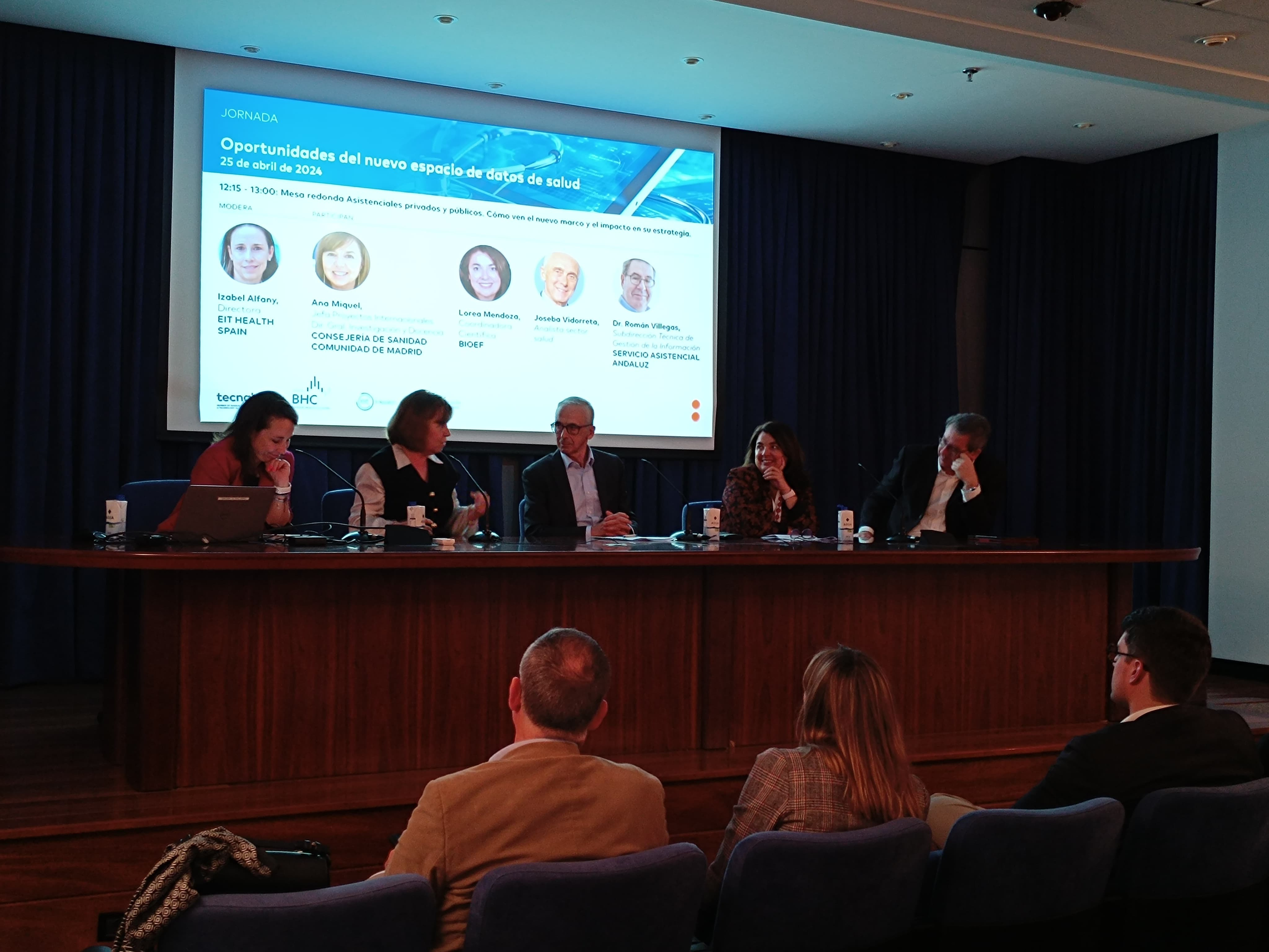
The event "Oportunidades del nuevo espacio de datos de salud" organised by TECNALIA Research & Innovation in collaboration with Basque Health Cluster and EIT Health Spain and, was a great opportunity to learn how different regions are preparing for the new European Health Data Space (EHDS) regulations. We were thrilled to welcome amazing speakers including Idoia Muñoz, Director of the Basque Health Cluster; Izabel Alfany, Director of EIT Health Spain; and Borja Bonail, TECNALIA researcher and expert in AI, Robotics and Digital Health.
The EHDS initiative by the European Commission aims to enhance healthcare data access across the European Union (EU). It seeks to benefit individuals, healthcare professionals, researchers, and policymakers by improving health data access and maintaining stringent data protection standards.
The primary objective of the EHDS is to establish a unified digital health environment that allows secure access and use of EU citizens' data for numerous positive outcomes. For patients, EHDS is designed to increase control over their health data, enabling more active health management and informed treatment decisions. The Xshare project (financed by the EU) also promotes patient empowerment by facilitating easier access to health records across EU countries, which could enhance quality of care for all European patients.
Healthcare professionals benefit from access to extensive health data, improving diagnostic accuracy and treatment efficacy, leading to better health outcomes and personalised care. Access to comprehensive data also supports population health management, by highlighting trends and informing preventive care strategies.
Researchers benefit from the rich data resource EHDS provides, accelerating medical research and innovation. Access to population health data support the development of effective treatments and groundbreaking health interventions.
For policymakers, EHDS is a valuable tool for crafting well-informed, effective health policies. Analysing detailed health data helps identify public health trends, evaluate the impact of interventions, and better allocate resources to support the improvement of health systems and services across the EU. The EIT Health Think Tank report "Implementing the European Health Data Space across Europe" (April 2024), was published following a series of roundtable discussions in 11 countries, involving around 100 leaders in public health, healthcare, innovation and health data economics from across the EU. The report provides practical recommendations for the agents leading the transformation at local, national and EU levels to ensure a harmonised and inclusive European approach.
This event focused specifically on exploring readiness and approach to how EHDS will be implemented across Spain.
Spain's capabilities for EHDS implementation are supported by its digitally mature healthcare system. Spain is uniquely positioned to lead the process of implementing the European Health Data Space regulation across Europe. It was ranked among the top five out of 17 OECD countries with the most advanced digital healthcare systems in the Bertelsmann Foundation’s 2019 Digital Health Index (https://www.bertelsmann-stiftung.de/en/publications/publication/did/smarthealthsystems), it is a world leader in clinical research (https://www.clinscience.com/news/spain-the-future-of-clinical-trials/), with different strategies and programmes at a public level, as well as funding to advance the digital transformation of the healthcare system. Spain has also been included in the group of leading countries for policy and implementation, specifically in the subcategory of infrastructure, with progress similar to known role model countries like Denmark or Finland (https://theodi.org/insights/projects/discover-how-ready-your-country-is-for-the-secondary-use-of-health-data/). However, a critical need exists for a comprehensive legal framework tailored to health data management and protection to ensure compliance with EU regulations and maintaining data security.
Implementation Dimensions:
-
Governance: Essential for managing EHDS implementation, involving coordination between national and EU authorities.
-
Capacity and Skills: Building capabilities in data management, security, and health informatics within the healthcare sector is crucial.
-
Funding Resources: Sufficient funding is needed for both initial rollout and ongoing operations, including IT infrastructure and training programs.
-
Data Quality: High-quality, standardized data collection and storage are paramount for effective health research and policy-making.
-
Primary and Secondary Data Use: Guidelines for repurposing health data for research and policy-making must protect privacy and data security.
-
Awareness and Education: Enhancing understanding of EHDS benefits and data privacy issues among all stakeholders is vital.
A point that was emphasized by all speakers during the event was the need for skilled professionals capable of managing data collection. The majority of health data is collected by healthcare professionals whose main priority is attending to and caring for their patients. Minimising the administrative burden of data collection would enable these healthcare professionals to collect the necessary data in less time and to a higher degree of accuracy.
This means that while the amount of data we have access to has increased exponentially over the years, we are still in the process of making effective use of this data. And for that, there is a need for professionals with enough experience and specialised skillsets to address the complexities that come with implementing a complete digital transformation of the system.
The challenge spans from the initial data acquisition to the safety, anonymisation and appropriate storing of the data. Not only do we need data experts, but also ‘change management’ leaders that can make the transition as smooth as possible by minimising barriers and drawing on learnings from other regions. Regional administrations are in the process of developing a proper framework for interoperability, which is going to be essential to make the most of this highly atomized ecosystem.
As interoperability makes it possible for data to be shared between organizations and regions, it opens up the possibility of secondary use of data. If we consider data usage with a patient as “primary use of data”, we can consider the aggregation of this data with others for population health management as “secondary use of data”.
Projects like Infobanco, started in Madrid and headed by the company Better, a pioneer in the field of openEHR, demonstrate previous attempts by Spain to implement a system facilitating sharing of healthcare data.
Secondary use of data not only needs the right personnel to make use of it, but also clear communication with patients so they can understand how this information could benefit public health and reassure them that sharing their data is safe and secure. Patients consent is vital for the process, and effectively implementing the EHDS requires a step of advocacy to settle any possible concern the population could feel.
In Spain, public health is the predominant means for the population’s access to healthcare, but this doesn’t mean that the private sector has no voice. The lack of healthcare professionals, from doctors to nurses and technicians, in the public sector places a considerable burden on primary healthcare. In many cases, this gap is being filled by the private sector. This means that, as the speaker Joseba Viderreta mentioned, both systems need to work together, because the private sector also acts as a support for patients and holds a significant portion of their information.
To perform this digital transformation and implement the EHDS, many different organizations will have to make effective use of their resources by understanding the relative importance of different processes and how to prioritize what is important and urgent, as opposed to what only seems important and urgent.
As previously mentioned, Spain is in a strong position to lead the implementation of EHDS across Europe, as evidenced by the EIT Health Spain Think Tank report “Implementación del Espacio Europeo de Datos Sanitarios en España: ¿es realmente factible?” which consulted leading Spanish experts across public and private sector. This group of data, health systems, legal, health innovation and patient organisations analysed risks and opportunities associated with the project prior to launching and concluded that Spain was well equipped to deliver the introduction of the EHDS.
While it might take some time to see the complete implementation of this initiative, what is certain is that it is an essential step for the progress of healthcare. We are learning that personalization of healthcare is critically important for improving patient outcomes, and the potential of digital twins and similar technologies are significant to make healthcare faster, cheaper and safer. The EHDS will become a central pillar for digital transformation and the development of healthcare in the future.
Written by Adam Skali